Writings
Some stories just lend themselves to amusing write-ups. Here are some of my favourites:
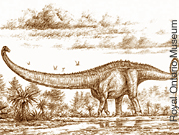
Dinosaur curator finds ultimate “skeleton in the closet”

[
11/15/2007] — “Gordo”, the largest skeleton ever to be displayed in Canada, has re-emerged from the dust - literally.
Dr. David Evans, Associate Curator of Vertebrate Palaeontology for Royal Ontario Museum, chanced upon the rare find amidst the ROM’s own collections.
“This is a fascinating and somewhat humorous story,” said the ROM’s Director and CEO William Thorsell.
A piece of ancient history
Evans was charged recently with finding a sauropod dino to display in the museum’s new Age of Dinosaurs gallery.
“This is the type of dinosaur that comes to mind when people think about dinosaurs. Its huge size and instantly recognizable long neck and long tail…capture people’s imagination,” says Evans.
After considering numerous options, including digging one up, Evans found what he was looking for in the unlikeliest of places: the museum itself. He was tipped-off to the hidden specimen, he says, by an article written by a famous sauropod expert, Jack McIntosh.
A reference to a rare Barosaurus skeleton at the ROM caught Evans’s eye, and sent the curator on a modern-day dino hunt.
“Under our noses”
Evans was able to show that what staff previously thought were isolated bones scattered throughout the collections room actually belonged to a single dinosaur: Gordo.
“It was an exciting day,” says Evans. “We were searching for an iconic sauropod skeleton, and we had one under our noses the whole time. When all the parts were pulled together, we realized just how much of the animal the ROM actually had - the better part of a skeleton of a rare, giant, dinosaur.”
Movin’ on up
Once completed and installed, the dino will be the centerpiece at the gallery; it will be the only sauropod skeleton consisting largely of real fossil bone and the largest ever on permanent display in Canada - quite a promotion for one previously-forgotten dino.
Gordo will appear alongside a T.Rex, Triceratops, and a Stegosaurus.

E-mails are full of regret, confusion: study
To all those Canadians who feel unfulfilled after hitting the send button, you’re not alone, says a recent survey released by Microsoft Canada.
While e-mail and instant messaging may be the communication mediums of choice, Canadians say lack of emotion in written messages frequently causes conversations to be misinterpreted.
RE: The numbers
While more than one-quarter of Canadians say they use e-mail for business purposes, 32 per cent of those users say they’ve had an e-mail misunderstood and 62 per cent say they need to spend additional time explaining the context or tone of a message to a colleague after sending.
The study also found that while e-mail is considered fast, people still spend at least half an hour a day re-reading messages to ensure tone and context carry through accurately.
In addition, 67 per cent of respondents admitted that they follow-up on important e-mails with a phone call, adding further time to their communications.
As for face-to-face communication becoming obsolete, 89 per cent still prefer good-old-fashioned chat when communicating important issues.
Re: RE: Making e-mails more effective
So why send e-mail in the first place? Physically switching from e-mail to phone is disruptive to your workflow, respondents say. Many also don’t want to bother with trying to track down multiple phone numbers.
“Canadians are looking for ways to better express and more clearly convey their meaning and intent through e-mail,” said Warren Shiau, a Lead Analyst at Microsoft. “The majority of respondents indicate they feel a need to use expressive tools like emoticons and Caps Lock in business e-mails to make sure the right message gets out. This points to a need to enrich messages with alternative communication methods such as voice.”
Virgin Komodo dragon becomes mom…and dad
[2007/01/24] — A female Komodo dragon who has never mated or even been around a male became the sole parent of five baby dragons this week, British scientists announced.
Flora the dragon fertilized her eggs on her own in what led to parthenogenesis - or virgin birth.
While other lizards also have the capacity to self-fertilize, scientists say this is the first time they have seen that a Komodo dragon can do it.
Scientists announced in December in the journal Nature that Flora was pregnant.
The hatchlings were 40-45 cm long and weighed as much as 125 grams. They are currently in a special area of the Chester Zoo in England, where they are being cared for and fed their daily serving of crickets and locusts.
Two eggs are still in the incubator, and zoo officials are awaiting their grand debut.
“When the first of he babies hatched, we didn’t know whether to make her a cup of tea or pass her the cigars,” Kevin Buley, a curator at the Zoo told Reuters.
Komodo dragons are the world’s largest lizards, with an average length of about 2-3 metres. They are native to various islands of Indonesia, where they can live for over 40 years.
Sorry it’s late: New insights into procrastination…
[2007/01/12] — Dr Piers Steel, a University of Calgary professor, is likely the world’s leading figure on the subject of doing things tomorrow when they could be done today - at least from a scientific point of view. He should know. His own study took ten years to complete.
When tomorrow turns into today
All kidding aside, Steel’s meta-analysis of 691 other research sources reveals some rather unexpected findings, among which are:
Predictors
Steel’s study, published in the recent edition of the American Psychological Association’s Psychological Bulletin, also discusses personality traits of those most likely to fall victim to the tendency:
“Essentially, procrastinators have less confidence in themselves, less expectancy that they can actually complete a task,” Steel says in a recent release. “Perfectionism is not the culprit. In fact, perfectionists actually procrastinate less, but they worry about it more.”
Other character traits that unfairly predisposition those prone to procrastination include:
Diamonds are forever…and apparently from space
[2007/01/10] — U.S. geologists say they have discovered the origins of rare and mysterious black diamonds: interstellar space.
It sounds like science fiction, but it’s just everyday science, retrieved using your friendly neighbourhood particle accelerator:
A team from Florida International University and Case Western Reserve University set out to trace the diamond’s source. Led by Stephen Haggerty, the team conducted their research using infrared radiation from the synchrotron at Brookhaven National Laboratory.
There, they discovered that these black ’space’ diamonds - also known as carbonado diamonds - contain trace elements nitrogen and hydrogen, sure indicators of an extraterrestrial origin.
The scientists point out that while approximately 600 tonnes of conventional diamonds have been mined and traded since 1900, not one of the world’s mining fields ever yielded a black diamond - one that looks like porous charcoal.
All regions conducive to conventional diamonds - from Australia to Siberia to China and India - are not compatible with the formation of black diamonds, Haggerty said in a release.
Black diamonds are found only in Brazil and the Central African Republic.
This study supports previous findings by Haggerty that suggest black diamonds formed in stellar supernovae explosions and were the size of asteroids when they landed at particular locations on Earth.
Love hurts for some cricket lovers
[2006/12/14] — Romantically-inclined crickets who try to woo partners by singing may be wooing some unwelcome visitors as well - parasites.
Upon hearing the male cricket’s call, these intrusive creatures bring along their larvae, leaving them to burrow into their passionately engaged hosts. Here they grow for about a week, feeding on their host’s nonessential organs until they are big enough and ready to break out in Alien-esque fashion.
Once they emerge from their dying host, they pupate and metamorphose into full flies waging havoc anew.
University of Florida researchers discovered that crickets were so affected by these parasites, both males and females changed their mating habits; the males stopped singing as much during fall months when parasites were abundant, and females stopped responding as much during the same time.
In experiments scientists discovered that only about 43 per cent of males sung in the fall, compared to 75 per cent in the spring. Similarly, females were more likely and more earnest in their approach in the springtime, when there are no parasites.
It comes down to a cost-benefit analysis for the crickets: serenading the ladies is more likely to ensure mating success, but it does come at a high potential cost for both.
For the time being, it seems those crickets in want of some romance will also need to find new ways to protect their privacy.
Condition causes some to ‘taste’ words
[2006/11/24] — Hearing a word such as “steak” or “chocolate” conjures up vivid images for many of us. In fact, the sensation may feel so real we can almost taste the word.
But for a small percentage of the population, even apparently random words such as “running” or “book” may bring up very real experiences of taste.
These people have synesthesia, essentially a crossing of the senses.
In synesthetes, parts of your brain that don’t normally communicate with each other do, causing the perception of one sense to involuntarily and irrepressibly prompt the experience of another.
In most commonly-reported cases, people experience colours when they hear a letter or number.
But Julia Simner of University of Edinburgh in Scotland and co-author Jamie Ward wish to learn about those even-more rare individuals for whom words trigger taste.
Their study, published in the journal Nature, found that it’s the meaning of a word that triggers the sensation of taste, so understanding it was a precondition.
Simner told Reuters that synesthesia is triggered by the part of the brain that encodes the meaning of the words, not the part of the memory that encodes the way the word sounds.
This is why some can taste the word even before they say it.
No one really knows how common synesthesia is, but current estimates are that one in every 1,000 people experience words, sounds and numbers as colours, tastes or smells.
Mexico’s Aztec idol may be emperor’s headstone
[2006/11/17] — Mexican Archeologists say that the largest Aztec idol ever uncovered may be honouring one of the ancient civilization’s last rulers.
Uncovered in October, scientists say the carving may be a headstone of Ahuizotl - the eighth Aztec ruler - who died shortly before the arrival of Spanish conquistadors.
The monolith has a surface area of 14 metres and a weight exceeding 12 tonnes. The headstone is covered with an intricately-carved, full-body image of the god Tlaltecuhtli, who bares a giant male head framed by a mass of curly hair. The figure also extends a sharp tongue representing a stream of blood.
Images of the statue betray hints of its former colours, while skulls and crossed bones surround the body.
Archeologists also discovered several dots on the piece thought to be a time stamp dating the sculpture to 1502.
The idol was discovered under the ruins of Mexico City’s Templo Mayor, an Aztec temple used for human sacrifice.
The Aztecs were a warlike people known for their advanced calendar systems and other monumental works, including pyramids. Their civilization stretched from the Gulf of Mexico to the Pacific Ocean, and encompassed much of modern-day central Mexico until the Spanish arrived in 1521.
The find is one of the most important ever in a country known for its ancient relics.
Tomboy fruit flies cause a stir
[2006/11/20] — Scientists have found a way to make gender-bending girl fruit flies fight like boys (and boy fruit flies fight like girls.)
The fly gene dubbed “fruitless” is at the root of the differences between sex-specific fighting styles.
Whereas female flies typically shove and head-butt their opponent’s body, males lunge, box and snap their forelegs to flatten their foe.
By swapping the “fruitless” gene in male and female fruit flies, researchers from Harvard Medical School and the Institute of Molecular Pathology in Vienna were able to observe a switch in fighting styles.
The fly gene responsible for the aggressive behaviour is also helping researchers understand the biological causes of aggression.
It’s the body that counts
The same study also inadvertently found that male fruit flies weren’t too picky when it comes to their mates - at least where heads are concerned. On or off, it’s the body that counts.
The male fruit flies didn’t appear too troubled when their mate is a dead, headless female fly, as they would still sometimes try to copulate with her.
The study, appearing Sunday in the journal Nature Neuroscience, is shedding light on complex behaviours in simple organisms while ultimately trying to gain insight into human behaviour.
